


A woman once told a story about her cousin, a Jesuit, who began his retreats with the words: "The fulfillment of love is sacrifice, its measure is the absence of selfishness." Sounds beautiful and noble, right? However, she was asked:
– "Would you like me to love you at the expense of my happiness?"
– "Yes," she replied.
And here lies the trap: "She would love me at the expense of her happiness, and I would love her at the expense of my happiness. And so, as a consequence, we would have two unhappy beings."
This wonderful paradox from Anthony de Mello's book strikes at the very heart of the biggest and most destructive myth in our relationships.
The Myth of Servile Love – Why Do We Believe We Must Suffer?
Many of us, especially women, grow up in a culture that glorifies martyrdom. We were taught that love is measured by how many things you can give up for the good of your partner, family, or children. We abandon our passions, rest, and sometimes even our own values to prove our commitment.
We equate love with the loss of autonomy. We feel that if we put our needs on par with another person's needs, we are selfish. The problem is that such thinking does not build closeness. It builds a relationship based on debt.
The Hidden Bill, or Why Your Sacrifice Breeds Anger
In psychology and Total Biology, we know that nothing disappears into a vacuum. If you constantly push your needs into the background, you subconsciously start handing your partner a bill. An expectation arises: "Since I gave up so many things for you, you should return the favor."
When the partner doesn't do this (because they often didn't ask for our sacrifice in the first place!), anger, frustration, and resentment are born within us. We fall into the Victim Trap. We start throwing accusations: "I gave you the best years of my life." This is a massive emotional conflict, which the body often manifests as chronic fatigue, thyroid problems (conflict of not having time for oneself), or back pain from carrying "someone else's burden".
Notice how much this phenomenon connects with our hallucinations about the other person – you can read more about this mechanism in my post about projection in relationships.
Healthy Selfishness is Not Egoism – It's the Foundation of a Relationship
True egoism is demanding that someone else live according to your expectations.
Healthy selfishness is making sure that you have the strength to live your own life.
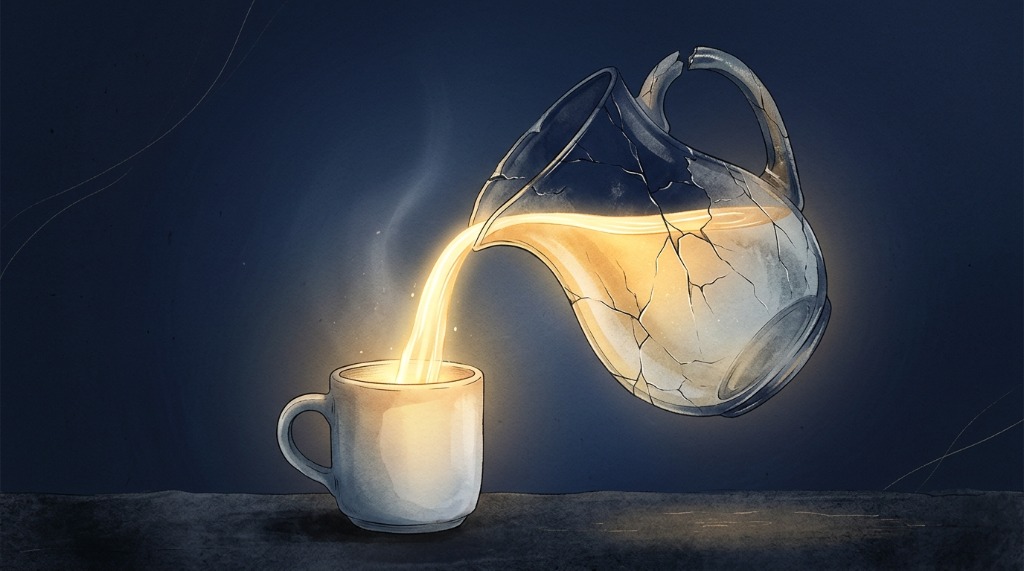
No one can give happiness to another person if they are internally "empty". You cannot pour from an empty cup. Depending on a partner for your own self-worth is risky and unfair. Happy couples are those in which two complete people, taking care of themselves, decide to walk through life together. They do not expect the other person to patch up their internal voids.
How to Stop Sacrificing and Regain Balance?
Acknowledge that your happiness is your responsibility.
No one else is responsible for it.
Observe your intentions.
Before you give up something important to you "for the good of the relationship," ask yourself: Am I doing this out of love and abundance, or out of fear of rejection and the desire to be "good"?
Start communicating your needs.
Regaining your voice can be difficult, and your partner may initially resist the new boundaries. Persevere. Assertiveness is not an attack; it's the protection of your vital energy.
Get rid of guilt.
Guilt is just a signal from your ego that you are breaking an old pattern. It is proof that you are finally starting to choose yourself.
Giving up on yourself is the worst thing you can do for your relationship. Two unhappy people will never build a happy home. Choose yourself so that you can truly, without hidden bills, choose another human being.
Do you feel this pattern applies to you?
Your body probably already knows it. Book a Recall Healing session – let's find your programming conflict and decode it together.
The article is for informational purposes and presents the perspective of Recall Healing. It does not replace medical diagnosis or treatment. Always consult symptoms with a doctor.