


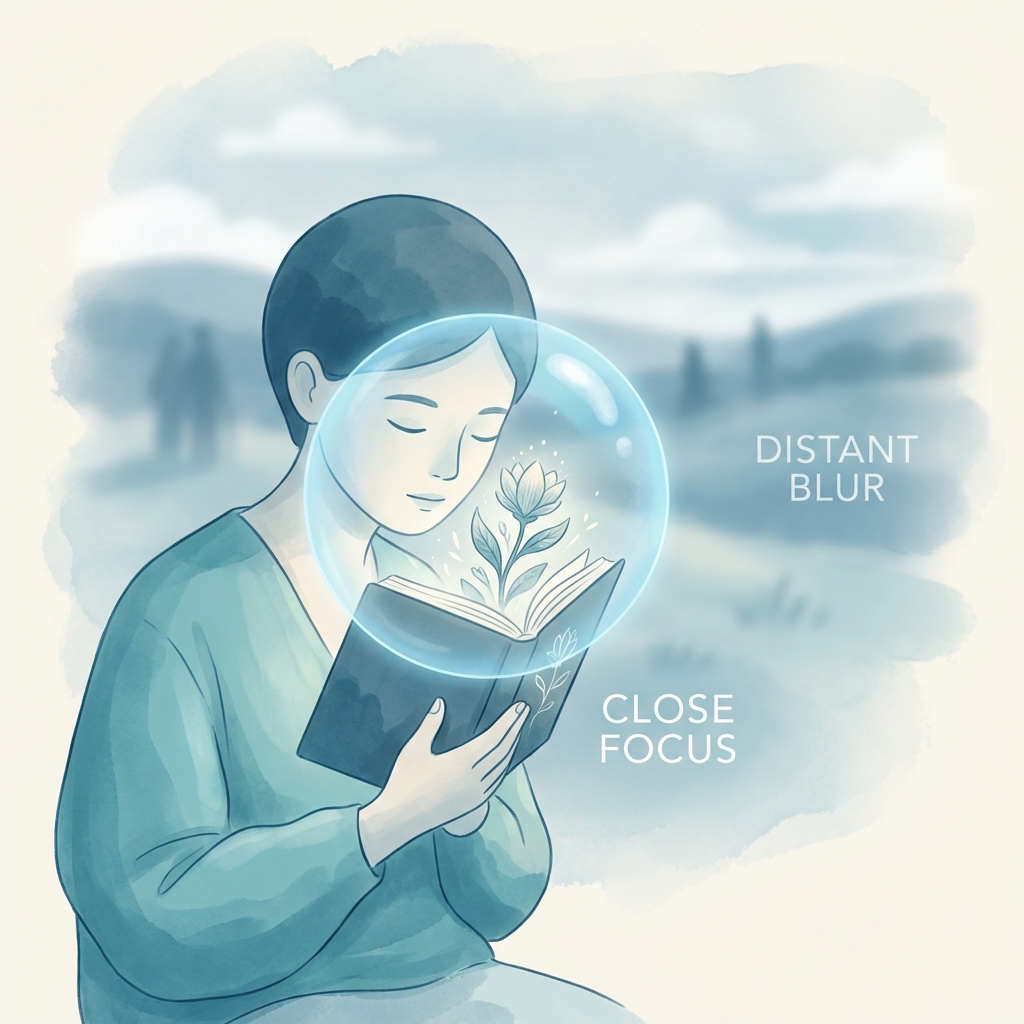
Have you ever wondered why your eyes suddenly stop seeing what is far away, focusing exclusively on what is close? In psychosomatics, short-sightedness is a conflict of fear and apprehension about what is in your immediate environment. Biological stress increases as a real or symbolic threat approaches, forcing the body to adapt.
Safety in the Future
Short-sightedness is a biological shield. To have clarity in the distance, you need to feel safe with what lies on your horizon.
Sense of Control
Identify what in your future feels "dangerous." Name that threat so it stops being a vague, blurry fear.
Field Expansion
Practice mindfulness on what is distant. Literally and symbolically plan the future from a position of trust, not avoidance.
Release the Past
Check if your vision is failing so you "don't see" a repeat of difficult childhood events on the horizon of adulthood.
"Sharp vision is the courage to look truth in the eye, no matter how far away it stands."
Biological mechanism of short-sightedness
Our eyes have cells specialized in distance vision and those adapted for near vision. In a conflict situation, the eye rotates slightly to align the pupil with the part of the retina that better processes information coming from close range. This happens because at that moment, long-distance vision is neither efficient nor needed – the priority is to avoid the danger that is right next to us.
When does the vision defect appear?
This process occurs in cycles:
- Active phase: The eye adapts to near vision to "find proof" of something or avoid ambiguity.
- Healing phase: Swelling appears, causing temporary blurred vision.
- Blockage: If the conflict returns regularly, the cells' ability to adapt becomes exhausted. When the swelling covers all specialized cells, the eye gets locked in a position that prevents sharp distance vision – this is how permanent short-sightedness develops.
Real life examples: From child to adult
The context of short-sightedness often reaches back to childhood. It can be a child's fear of being hit or spanked by a parent. another example is the child of an alcoholic who listens tensely for their father's return home – the threat is close, so the eyes must be ready to react at close range.
In adulthood, short-sightedness can deepen when, for example, we feel the "breath" of a boss with whom we have tense relations on our neck. Even sentences repeated at home, such as: "I hope you won't be like your father", can become a biological trigger for a short-sighted person.
Questions for reflection
If you wear "minus" glasses, these questions may help you find the emotional source of your defect:
- What in my future do I not want to see? What makes me prefer to look only at what is "here and now"?
- Who or what in my distant environment do I fear? Is there an old threat there that I am still avoiding?
- Did I have to be alert to what was happening close to me in childhood? (e.g., parents' moods, atmosphere at home).
- What situation made me feel: "This is too much for me, I don't want to look at it"?
- Do I feel safe only when I have everything under strict control within reach?
The article is for informational purposes and presents the perspective of Recall Healing. It does not replace medical diagnosis or treatment. Always consult symptoms with a doctor.