

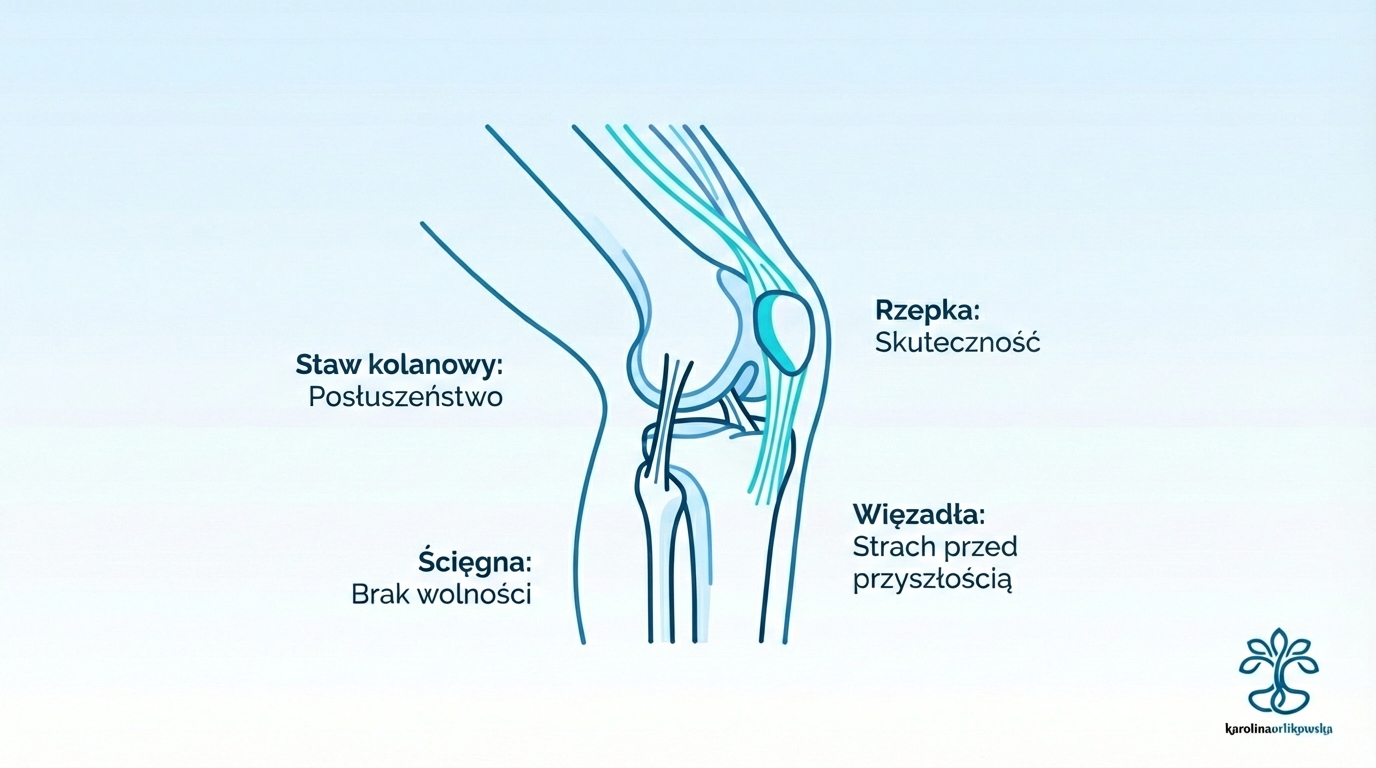
Problems with the musculoskeletal system are not just the result of physical overload or injury. In Recall Healing, every symptom has its emotional source. Knees, tendons and ligaments carry information about our freedom, self-worth and relationships with others.
If your knee hurts "for no apparent reason" or the pain returns despite treatment, it's worth asking yourself: what is my body trying to tell me?
Whom do You Refuse to Bow Down to?
In Recall Healing, the knee is the joint of submission and humility. Pain appears when your Ego says "no," but a situation or authority forces you to "bend."
Two Sides of the Conflict:
Forced Submission:
"I must do this, though I hate it. I feel humiliated by having to listen to this person."
Lack of Flexibility:
"I will not bend at any cost. My way is the only right way (resistance to changing course)."
Ask yourself: Is submission a loss of dignity for you, or perhaps a wise strategic choice?
Knee pain is a signal that the situation you are in strikes at your sense of self-worth, not something trivial. Knee pain often symbolizes forced obedience or obligation. It is a metaphorical "kneeling" before someone or begging for something. In Recall Healing, the knee is a joint that "bends" – and therefore represents our ability (or inability) to submit, give in, accept something.
In this area, conflicts are recorded related to:
Tendons: lack of freedom and sense of helplessness
Tendons connect muscles to bones and are responsible for our ability to act. In Recall Healing, tendons represent a sense of inability to take even a small but important step towards a goal.
This is often accompanied by the thought:
"I will never be able to do this" or "My effort is not appreciated anyway."
In athletes, tendon injuries often result from a deep sense of being "not good enough" – despite objective successes. It's the inner critic that says whatever we do is not enough.
Ligaments: fear of the future and being torn
Ligaments stabilize joints and connect bones. Emotionally, they are linked to a conflict of low self-worth directed towards the future.
This is a sense of being torn in actions and fear that whatever we do, we will not succeed. It can also be:
Ligaments say: "I am torn between what I want and what I must do."
Patella: effectiveness and efficiency
The patella protects the front of the knee joint and enables efficient leg extension. Patella problems often indicate a sense of powerlessness and lack of strength.
This is the conflict of a person who feels ineffective or from whom more is demanded than they can give. A common theme is:
Deeper meaning: birth and creation
The knee joint is biologically linked to creation and birth. Historically, women gave birth in a squatting position, and the father, by placing the newborn on his knees, symbolically acknowledged his paternity.
Therefore, knee challenges can direct our attention towards:
Reflection Questions
If you are struggling with knee, kneecap, or tendon pain, it's worth asking yourself a few questions:
Ask yourself:
Whom or what am I "falling on my knees" before? Do I have to submit against my will?
Do I feel good enough in what I do? Where does this feeling come from?
Am I torn between two options? Do I have to "break" something or stay?
Are there themes of difficult births or lack of paternity acknowledgment in family history?
These questions do not replace a medical diagnosis, but they can open the door to a deeper understanding of why your body reacts in a certain way.
The article is for informational purposes only and presents the perspective of Recall Healing. It does not replace medical diagnosis or treatment. Always consult symptoms with a doctor.